Showing posts with label Schism. Show all posts

Friday, March 29, 2013

Yahoo! reports on the Sour Grapes of Pseudo-Traditionalists concerning Antipope Francis' Liturgical Abuse

Pseudo-Traditionalists spew sour grapes concerning Francis I's Modernist revival through Liturgical Abuse, which is of course Child Abuse (See Bergoglio Washes Ratzinger's Novus Ordo Reform of the Reform towards greater Modernism). 

Disclaimer: The AP thinks Jorge Bergoglio is a valid Pope, but true Traditionalists of the Catholic Religion reject him as an Antipope.

Pope's foot-wash a final straw for traditionalists
By NICOLE WINFIELD | Associated Press


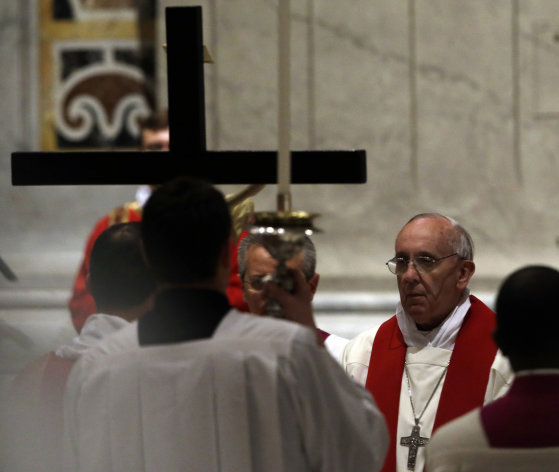
Associated Press/Gregorio Borgia - Pope Francis, right, looks up to the Crucifix during the Passion of Christ Mass inside St. Peter's Basilica, at the Vatican, Friday, March 29, 2013. Pope Francis began the …more


VATICAN CITY (AP) — Pope Francis has won over many hearts and minds with his simple style and focus on serving the world's poorest, but he has devastated traditionalist Catholics who adored his predecessor, Benedict XVI, for restoring much of the traditional pomp to the papacy.

Francis' decision to disregard church law and wash the feet of two girls — a Serbian Muslim and an Italian Catholic — during a Holy Thursday ritual has become something of the final straw, evidence that Francis has little or no interest in one of the key priorities of Benedict's papacy: reviving the pre-Vatican II traditions of the Catholic Church.

One of the most-read traditionalist blogs, "Rorate Caeli," reacted to the foot-washing ceremony by declaring the death of Benedict's eight-year project to correct what he considered the botched interpretations of the Second Vatican Council's modernizing reforms.

"The official end of the reform of the reform — by example," ''Rorate Caeli" lamented in its report on Francis' Holy Thursday ritual.

A like-minded commentator in Francis' native Argentina, Marcelo Gonzalez at International Catholic Panorama, reacted to Francis' election with this phrase: "The Horror." Gonzalez's beef? While serving as the archbishop of Buenos Aires, the then-Cardinal Jorge Mario Bergoglio's efforts to revive the old Latin Mass so dear to Benedict and traditionalists were "non-existent."

Virtually everything he has done since being elected pope, every gesture, every decision, has rankled traditionalists in one way or another.

The night he was chosen pope, March 13, Francis emerged from the loggia of St. Peter's Basilica without the ermine-rimmed red velvet cape, or mozzetta, used by popes past for official duties, wearing instead the simple white cassock of the papacy. The cape has since come to symbolize his rejection of the trappings of the papacy and to some degree the pontificate of Benedict XVI, since the German pontiff relished in resurrecting many of the liturgical vestments of his predecessors.

Francis also received the cardinals' pledges of obedience after his election not from a chair on a pedestal as popes normally do but rather standing, on their same level. For traditionalists who fondly recall the days when popes were carried on a sedan chair, that may have stung. In the days since, he has called for "intensified" dialogue with Islam — a gesture that rubs traditionalists the wrong way because they view such a heavy focus on interfaith dialogue as a sign of religious relativism.

Francis may have rubbed salt into the wounds with his comments at the Good Friday procession at Rome's Colosseum, which re-enacts Jesus Christ's crucifixion, praising "the friendship of our Muslim brothers and sisters" during a prayer ceremony that recalled the suffering of Christians in the Middle East.

Francis also raised traditional eyebrows when he refused the golden pectoral cross offered to him right after his election by Monsignor Guido Marini, the Vatican's liturgy guru who under Benedict became the symbol of Benedict's effort to restore the Gregorian chant and heavy silk brocaded vestments of the pre-Vatican II liturgy to papal Masses.

Marini has gamely stayed by Francis' side as the new pope puts his own stamp on Vatican Masses with no-nonsense vestments and easy off-the-cuff homilies. But there is widespread expectation that Francis will soon name a new master of liturgical ceremonies more in line with his priorities of bringing the church and its message of love and service to ordinary people without the "high church" trappings of his predecessor.

There were certainly none of those trappings on display Thursday at the Casal del Marmo juvenile detention facility in Rome, where the 76-year-old Francis got down on his knees to wash and kiss the feet of 12 inmates, two of them women. The rite re-enacts Jesus' washing of the feet of his 12 apostles during the Last Supper before his crucifixion, a sign of his love and service to them.

The church's liturgical law holds that only men can participate in the rite, given that Jesus' apostles were all male. Priests and bishops have routinely petitioned for exemptions to include women, but the law is clear.

Francis, however, is the church's chief lawmaker, so in theory he can do whatever he wants.

"The pope does not need anybody's permission to make exceptions to how ecclesiastical law relates to him," noted conservative columnist Jimmy Akin in the National Catholic Register. But Akin echoed concerns raised by canon lawyer Edward Peters, an adviser to the Vatican's high court, that Francis was setting a "questionable example" by simply ignoring the church's own rules.

"People naturally imitate their leader. That's the whole point behind Jesus washing the disciples' feet. He was explicitly and intentionally setting an example for them," he said. "Pope Francis knows that he is setting an example."

The inclusion of women in the rite is problematic for some because it could be seen as an opening of sorts to women's ordination. The Catholic Church restricts the priesthood to men, arguing that Jesus and his 12 apostles were male.

Francis is clearly opposed to women's ordination. But by washing the feet of women, he jolted traditionalists who for years have been unbending in insisting that the ritual is for men only and proudly holding up as evidence documentation from the Vatican's liturgy office saying so.

"If someone is washing the feet of any females ... he is in violation of the Holy Thursday rubrics," Peters wrote in a 2006 article that he reposted earlier this month on his blog.

In the face of the pope doing that very thing, Peters and many conservative and traditionalist commentators have found themselves trying to put the best face on a situation they clearly don't like yet can't do much about lest they be openly voicing dissent with the pope.

By Thursday evening, Peters was saying that Francis had merely "disregarded" the law — not violated it.

The Rev. John Zuhlsdorf, a traditionalist blogger who has never shied from picking fights with priests, bishops or cardinals when liturgical abuses are concerned, had to measure his comments when the purported abuser was the pope himself.

"Before liberals and traditionalists both have a spittle-flecked nutty, each for their own reasons, try to figure out what he is trying to do," Zuhlsdorf wrote in a conciliatory piece.

But, in characteristic form, he added: "What liberals forget in their present crowing is that even as Francis makes himself — and the church — more popular by projecting (a) compassionate image, he will simultaneously make it harder for them to criticize him when he reaffirms the doctrinal points they want him to overturn."

One of the key barometers of how traditionalists view Francis concerns his take on the pre-Vatican II Latin Mass. The Second Vatican Council, the 1962-65 meetings that brought the church into the modern world, allowed the celebration of the Mass in the vernacular rather than Latin. In the decades that followed, the so-called Tridentine Rite fell out of use almost entirely.

Traditionalist Catholics who were attached to the old rite blame many of the ills afflicting the Catholic Church today — a drop in priestly vocations, empty pews in Europe and beyond — on the liturgical abuses that they say have proliferated with the celebration of the new form of Mass.

In a bid to reach out to them, Benedict in 2007 relaxed restrictions on celebrating the old Latin Mass. The move was aimed also at reconciling with a group of schismatic traditionalists, the Society of St. Pius X, who split from Rome precisely over the Vatican II reforms, in particular its call for Mass in the vernacular and outreach to other religions, especially Judaism and Islam.

Benedict took extraordinary measures to bring the society back under Rome's wing during his pontificate, but negotiations stalled.

The society has understandably reacted coolly to Francis' election, reminding the pope that his namesake, St. Francis of Assisi, was told by Christ to go and "rebuild my church." For the society, that means rebuilding it in its own, pre-Vatican II vision.

The head of the society for South America, the Rev. Christian Bouchacourt, was less than generous in his assessment of Francis.

"He cultivates a militant humility, but can prove humiliating for the church," Bouchacourt said in a recent article, criticizing the "dilapidated" state of the clergy in Buenos Aires and the "disaster" of its seminary. "With him, we risk to see once again the Masses of Paul VI's pontificate, a far cry from Benedict XVI's efforts to restore to their honor the worthy liturgical ceremonies."

http://news.yahoo.com/popes-foot-wash-final-straw-traditionalists-004235548.html


Friday, September 9, 2011

"The Failed Church" of Sean O'Malley

Modernism, Indifferentism, Pseudoecumenism, Liberalism, Feminism, Witchcraft, Rainbow Ministry, Liturgical Abuse--i.e. Child Abuse, etc. these are all aspects of the "The Failed Church" of Pseudbishop Sean O'Malley, from his own words:


Cardinal’s Decision Regarding the Archdiocese of Boston’s Publication With Respect To Its Clergy Accused of Sexual Abuse of a Child
August 25, 2011


My Dear Friends in Christ,

The Archdiocese of Boston’s commitment and responsibility is to protect children and to ensure that the tragedy of sexual abuse is never repeated in the Church. Since the crisis erupted in 2002, we have endeavored to regain trust by addressing the needs of survivors and those who have suffered as a result of clergy sexual abuse, investigating and responding to all allegations of misconduct involving minors, removing abusive priests from active ministry consistent with our zero tolerance policy, and creating and maintaining safe environments for children in our churches and schools. Much has been accomplished in Boston since 2002, but our work in this area is continuing, and we will remain ever vigilant.

The Archdiocese is continually evaluating its policies and practices to ensure that our child protection and abuse prevention efforts are further strengthened. Consistent with that effort, I have studied suggestions that we enhance the present Archdiocesan policy with respect to sharing information about clergy accused of sexually abusing minors. This is a complex issue involving several competing considerations. On the one hand, there is the critically important need to assure the protection of children and also important considerations related to transparency and healing; on the other, there are interests related to the due process rights and reputations of those accused clergy whose cases have not been fully adjudicated, including deceased priests who were not alive to respond to the allegations. After a careful study of our present policy in light of these considerations, as well as after a chance to consult with my advisors and advisory bodies, including the Presbyteral Council and Archdiocesan Pastoral Council, I am announcing today revisions to the policy of the Boston Archdiocese with respect to disclosing names of clergy accused of sexually abusing minors.

This revision comes after serious and thoughtful consideration and prayer by myself and many others. I am acutely aware of the harm that the abuse of children by clergy has caused in the lives of so many. And while I know there will be some who believe our policy changes should go further, after careful consultation and consideration of views expressed by many people and groups, I believe that the changes we are making are appropriate and I would like to share my rationale for arriving at this decision.

Since 2002, the Archdiocese has had in place a vigorous policy with respect to disclosing information about clergy accused of abusing minors. First and foremost, it is the policy of the Archdiocese to immediately report to law enforcement all allegations of clergy sexual abuse of children. These notifications are made to local District Attorneys’ offices, the Massachusetts Attorney General, and, when appropriate, federal law enforcement. These notifications are made whether or not the person reporting the abuse is still a minor, whether or not the accused cleric is still alive, and whether or not the allegations have been evaluated to have even the semblance of truth. Second, the Archdiocese publicly discloses when a member of its clergy is removed from active ministry pending an investigation into an allegation of child abuse. Finally, the Archdiocese publicly discloses when a member of its clergy is convicted of sexual abuse of a child as a result of a criminal process or when, after a canonical process, a member of the clergy is removed from the clerical state.

In addition to these disclosures in individual cases, the Archdiocese has released extensive information about the abuse cases in Boston. The Archdiocese published, in February 2004, a comprehensive report on the number of accused priests in the Boston Archdiocese, as well as the number of victims of those priests, in the period 1950-2003.1 This report compiled various key statistics regarding the allegations of abuse made against clergy in the Boston Archdiocese, as well as information on settlements that had been reached historically by the Boston Archdiocese. In addition to this report, the Archdiocese has published annual financial reports starting in 2006, including, among other financial information, information about the abuse settlements reached each year, the financial sources for those payments, and the related costs for Archdiocesan pastoral and child protection efforts.2 Additionally, the Archdiocese has produced extensive documentation with respect to past allegations of clergy sexual abuse both in response to requests from law enforcement and in civil litigation. Information from those files has been summarized in a report published in 2003 by the Massachusetts Attorney General’s office.3

The policy which I am announcing today will retain our present practices and also supplement them in key respects. First, the Archdiocese has created for its website (www.bostoncatholic.org) a compiled list of names of accused clergy in the following categories:
The names of all Boston Archdiocese clergy who have been found guilty of sexually abusing a child, either by the Church (canon law), the State (criminal law), or both. In the case of criminal convictions, the cleric either has been convicted after a criminal trial or has pled guilty to a crime involving the sexual abuse of a child. In the case of canonical processes, the clerics whose names are included either have been dismissed from the clerical state at the end of the canonical process, or have been assigned to a life of prayer and penance, with no ministry possible.
The names of all Boston Archdiocese clergy who have been laicized after having been accused of sexually abusing a minor. Laicization under Church law is a process whereby the priest voluntarily requests that he be separated from the clerical state.
The names of all clergy of the Archdiocese who have been publicly accused of sexually abusing a child where canonical proceedings remain to be completed. In each case, the cleric involved has been removed from public ministry and remains on administrative leave.
The names of Boston Archdiocese clergy who have been publicly accused of sexually abusing a child, but who had already been laicized and therefore were no longer in active ministry by the time the accusations were received.
The names of those deceased clergy of the Archdiocese who have been publicly accused of sexually abusing a child, but where criminal or canonical proceedings were not completed. In most of these cases, the accused priest had died before the allegations were received.

This represents the first time that names of accused clerics have been compiled by the Archdiocese in a central location and a readily accessible format.

Second, as to each member of the clergy whose name is listed in these categories, the Archdiocese has included in this website the following pertinent information: the cleric’s year of birth and year of ordination; whether the cleric is alive or deceased, and if deceased, the year of death; for members of the clergy who are alive, their status as well as the date of any laicization, dismissal, or conviction of the accused cleric; and a link to the cleric’s assignment history. This list, which is searchable, will be regularly updated as additional announcements are made in the future.

Third, I have decided to publish a separate listing of the names of those clergy who have been publicly accused of sexually abusing a child where the allegations have been found unsubstantiated by the Review Board after a preliminary investigation or where the priest has been acquitted after a canonical process. In a number of cases, these priests have been returned to active ministry.

The revised policy being announced today attempts to balance appropriately several considerations which bear on this matter:
The Church needs to be open about clergy accused of crimes against children in order to help foster the process of healing and restoration of trust.
Accused priests or deacons who have been laicized or dismissed are no longer in the clerical state and consequently no longer under the authority of the Archdiocese; to the extent they pose any ongoing risk to children, a comprehensive disclosure of their names may assist in addressing that risk.
Not only must the Archdiocese honor its commitment to protect children, it must also be mindful of the due process concerns of those whose guilt has not been established. In the present environment, a priest who is accused of sexually abusing a minor may never be able to fully restore his reputation, even if cleared after civil or canonical proceedings. Reputational concerns also become acute in cases concerning deceased priests, who are often accused years after their death with no opportunity to address the accusations against them.

In arriving at our revised policy in this area, I have carefully weighed these considerations. I also have considered what a number of other dioceses have done.

I believe that, to the extent possible, our revised policy addresses the concerns and views that have been expressed, is consistent with if not more expansive than civil law, and best balances the considerations mentioned above. In arriving at this revised policy, there were a few issues that were particularly difficult and I would like to comment briefly on them.

The first issue has to do with the listing of the names of deceased priests who have been accused of abusing a child. More concern was expressed as to this category than any other. As to deceased priests, there is, by definition, no consideration relating to child protection, and the countervailing considerations related to due process and protecting reputations become more substantial. In the vast majority of these cases, the priest was accused after he had already passed away and accordingly had no chance to address the allegations being brought against him. In a very large percentage of these particular cases, there has been a single allegation of abuse; that is not said by way of minimizing the allegations of misconduct, but rather to point out that there is little evidence on which to base a decision of guilt or innocence. It is extremely difficult to determine the credibility of these accusations, given that they involve matters that typically occurred decades ago.

After consideration of all perspectives, I have decided to include in our compiled list the names of deceased priests if the criminal or canonical proceedings against that priest were completed before his death or if the priest has already been accused publicly. I emphasize that our decision not to list the names of deceased priests who have not been publicly accused and as to whom there were no canonical proceedings conducted or completed (most were accused well after their death) does not in any way mean that the Archdiocese did not find that the claims of particular survivors who accused those deceased priests to be credible or compelling. Indeed, in many of those cases, the Archdiocese already has proceeded to compensate the survivor and provides counseling and pastoral care to those individuals.

Another issue which drew substantial commentary was whether a standard of “credibility” should be used to determine the listing of an accused priest. After consideration, I have decided not to rely on that term in making decisions about those accused clergy that should be listed on our website. The term “credibility” can have a variety of meanings, and, in this context, can mean anything from “plausible” but not proven, to “more likely than not” (the standard used in civil cases), to the high standard used for convictions in criminal and canonical cases (“beyond a reasonable doubt”/subject to “moral certitude”). I have decided instead to proceed by listing the names of clergy in the categories described above.

Another issue to which I have given substantial consideration has to do with listing names of accused priests who are not priests of the Boston Archdiocese, but are religious order priests or priests from other dioceses. After careful consideration, I have decided to limit the names that are being published on our website to clergy of the Boston Archdiocese. I have decided not to include names of religious order priests or priests from other dioceses on our list because the Boston Archdiocese does not determine the outcome in such cases; that is the responsibility of the priest’s order or diocese. I recognize that, over the years, many religious order priests and priests of other dioceses have served within the territory of the Boston Archdiocese, including in assignments at our parishes.

In its 2004 report, the Archdiocese published information with respect to the number of religious order priests and priests from other dioceses who had been accused of abusing minors while serving within the Archdiocese. Archdiocesan policy is that, as soon as an accusation of misconduct is received against a religious order priest or a priest from a different diocese, we immediately notify law enforcement, as well as the superior of that order or the bishop of that diocese, and revoke the accused priest’s faculties to minister within our Archdiocese. Under canon law, it falls to the superior or to the bishop to investigate and evaluate the accusation, taking appropriate canonical action. I urge the religious orders and other dioceses to consider their own policies with regard to publishing the names of accused clergy. I hope that other dioceses and religious orders will review our new policy and consider making similar information available to the public to the extent they have not already done so.

Lastly, I have considered what should be done with the names of priests as to whom allegations were found unsubstantiated. I have decided to include in a separate list the names of accused clergy where the accusations have been found not substantiated after an investigation by civil authorities or by the Church if the names of those priests are already in the public domain. The Archdiocese already makes an announcement when a priest who previously has been publicly removed from ministry is allowed to return to active ministry following an investigation. However, I have decided not to include the names of accused clergy against whom allegations have been found unsubstantiated where their names have not been previously publicized. I believe it would be unfair to these clerics to release their previously unpublicized names on a list of accused priests after civil or Church processes have already found the allegations against them to be unsubstantiated.

In total, 159 names of accused clerics of the Boston Archdiocese are included on the lists being published today. Of these, 22 represent cases that are still in process canonically, with the priest on administrative leave and having no public ministry. It is my wish and goal that these remaining cases be processed as expeditiously as possible. At the conclusion of those cases, additional announcements and amendments to the list will be made accordingly.

To put this information in context, there have been to date a total of 250 clerics of the Boston Archdiocese accused of sexually abusing a minor. There are 91 names that are not being included on the lists published today, which can be summarized as follows: 62 names of deceased clergy as to whom canonical proceedings were never conducted or completed and who have not been publicly accused; 22 priests of the Boston Archdiocese as to whom the accusations of misconduct with a minor could not be substantiated;4 4 priests or former priests of the Archdiocese who are not in active ministry and are the subject of a preliminary investigation; and 3 priests who were already laicized or dismissed by the time they were accused, and who have not been publicly accused.

It is important to note that the allegations of sexual abuse by Archdiocesan priests generally do not involve claims about current misconduct, but rather involve abuse occurring decades ago and before the Church adopted its current child protection policies. As described in detail in the report published by the Archdiocese in February 2004, the vast majority of the complaints received by the Archdiocese before 2004 involved incidents alleged to have occurred from 1965 to 1982, with a substantial decline in the number of incidents thereafter. More recent data, collected through 2010, confirm that same historical pattern. Only 4% of the 198 allegations received by the Archdiocese in the past six years involve child abuse alleged to have occurred more recently than 1990; over 90% of the incidents are alleged to have occurred before 1985. I do not say this in any way to minimize the abuse of minors by Boston priests, which is heinous, or the serious mistakes made by the Church hierarchy in responding to it. Nor do I seek to ignore the harm caused to survivors by these historical incidents, harm which is both current and the subject of our ongoing pastoral response. Rather I simply seek to place the problem in context and to give the faithful some confidence that the policies adopted by the Church to protect its children starting in the early 1990s have been effective.

These policies include equipping children to report abuse; training our clergy, volunteers, and staff to identify and report suspected abuse; conducting annual background checks for all clergy, volunteers, and staff; and upholding the norm of zero tolerance by ensuring that no priest who has sexually abused a child will be permitted to exercise any ministry. Since 2003, approximately 300,000 children have received safe environment training through their parish schools or religious education programs. Approximately 175,000 adults – including diocesan and religious order priests, deacons, candidates for ordination at Archdiocesan seminaries and in diaconate formation, educators, employees, parents, and volunteers – have been trained to recognize and report suspected abuse. More than 300,000 CORI checks have been conducted for Archdiocesan and religious priests, deacons, educators, volunteers, and other personnel working with children. Almost 400 reports of child abuse or neglect (51A reports) have been filed with the Department of Children and Families (formerly the Department of Social Services) by our parishes and schools since these safety programs began. The majority of reports were made as a result of a child self-disclosing abuse to someone in the parish. In almost all cases, the abuse involved someone in the child’s family, a neighbor, other children, or an adult known to the child.

The Archdiocese will supplement the lists being published today on its website on a regular basis and will continue to make announcements at key stages of individual cases, consistent with prior policy. In addition, nothing that is being announced today undercuts the continued willingness of the Archdiocese to discuss with individual survivors of abuse information with respect to the accused priest.

Despite our every effort to provide accurate and current information, in this first effort to provide a listing there will be errors and omissions. I would ask that anyone with additional information or corrections to the lists being published to contact our Delegate for Investigations at (617) 746-5639.

It is my belief that in amending our policy and organizing this information on our website so that it is readily accessible, we take one more step forward in our efforts to assume responsibility for our past failures and reaffirm our commitment to assure that our present day standards protect the children of our community. We recognize that this announcement may serve as a painful reminder of the wounds many survivors carry and we invite any individual who has been harmed by clergy sexual abuse to contact our Office of Pastoral Support and Outreach at (781) 794-2581 or (866) 244-9603. Having met with hundreds of survivors, I know firsthand the scars you carry. And I carry with me every day the pain of the Church’s failures. I express once again my sorrow for your pain and my apology for any way the Church and its clergy have failed you.

My deepest hope and prayer is that the efforts I am announcing today will provide some additional comfort and healing for those who have suffered from sexual abuse by clergy and will continue to strengthen our efforts to protect God’s children.

Sincerely Yours in Christ,


Archbishop of Boston

--------------------------------------------------------------------------------

1 Statement of Archbishop Sean P. O’Malley Regarding Clergy Sexual Abuse in the Archdiocese of Boston from 1950-2003, available at http://www.bostoncatholic.org/uploadedFiles/News_releases_2004_statement040226.pdf.
2 Available at http://www.bostoncatholic.org/annualreport.aspx?pid=508.
3 Available at http://www.bostoncatholic.org/PSO.aspx

4 Of these 22 priests, 4 are deceased, 8 are retired or on health leave, 1 has been restricted by the Archdiocese from engaging in active ministry for other reasons, and 9 are in active ministry without restriction.


http://www.bostoncatholic.org/publication.aspx

Tuesday, May 17, 2011

Fr (?) Z's Ratzi-Motu Mess 3.0 & Altar Girls


Motu-Mess 3.0 Complements of Antipope Benedict XVI

Recently Antipope Benedict XVI renewed his Motu Mess in 3.0 style after asking his wolves to show more respect to his plan to bring the Usage of Antipope John XXIII's 1962 Revised Latin Missal into Rosicrucian hermeneutical line with and practically complementing the Modernist destructions of Annibale Bugnini's Novus DisOrdo Amissae. In fact, on the 8th of May Fr. (?) Z and Damian Thompson reported on the sacrilege of altar girls involving the 1962 Latin Missal at the Fish House in Cambridge University of England thus exemplifying the Pseudo-Traditionalist/Neo-Modernist dilemma "The two complement each other, one is not higher than the other, and they only differ in expressions of the same faith" .

So reads the Z-Report about this abomination :

Dear Fr Zuhlsdorf,

I am sorry to confirm the rumour about the developments at Fisher House in Cambridge. As a result of the decisions to have female servers in the Extraordinary Form all servers who have been helping with the Masses in the Extraordinary Form in Fisher house have resigned; the congregation was much smaller than usual because some of the faithful (like me) decided not to come (and probably also because of lacking information on the Mass schedule, so it was not only out of protest), and some people left during the Mass. As someone who has been deeply involved in the liturgical life of Fisher House … I am very sorry about this development, and I hope that Ecclesia Dei will reply speedily to resolve the matter (I have written to them twice last year, when then chaplain first mooted this idea, but still have not received any official reply). However, I would like to stress that the Fr Alban has been an exemplary chaplain to Cambridge University, ….

http://wdtprs.com/blog/2011/05/tlm-with-female-servers-not-just-a-theory/

Does Fr. (?) Z condemn altar girls as evil? Nope! Therefore he consents to iniquity!

The Holy Catholic Church damns such evil practice of altar girls.

http://laicanetwork.blogspot.com/p/pontifical-catholic-magisterium-against_29.html

Motu-Mess means Apostasy & that's not the Holy Sacrifice of the Mass, put that Z in your pipe and smoke it!

Remember!

Liturgical Abuse is Child Abuse

www.laicanetwork.blogspot.com

Thursday, January 13, 2011

Midnight Novus Ordo Christmas 2010 with Pseudo-Epistle Babe


A Sacrilegious Service presided over by Antipope Benedict XVI was held in St Peter's Basilica on December 25, 2010 at Midnight Christmas Liturgy, wherein a woman pseudo-lectoress aka "Pseudo-Epistle Babe" falsely reads the Reading for Novus Ordo Service. This is a Feminist-Witchcraft Abomination of Desolation & Apostate Sacrilege, and can never be tolerated. Cf. video below at 29:25 ...


Wednesday, September 29, 2010

It's Not All For You! Irreverend James DiPerri abused "altar girls" on BCTV


Mortal Sin of Sacrilege - No, Dear Catholics - It's Not All For You!

On the Feast of Saint Wenceslaus, that is Tuesday, September 28th of 2010, a Modernist Sacrilege was celebrated by the Irreverend James DiPerri, who claimed to be from Our Lady Comforter of the Afflicted Parish in North Waltham, MA.

You will see two so-called female altar-boys (Katie & Sarah) usurping God's altar in violation of Sacred Tradition. This DiPerri is guilty of public sacrilege of schism and molestation of children.

You can see for free the entire on-demand video of this Novus Ordo abomination streaming online via BCTV (Viewer Discretion is Advised):


Please note the Pseudo-Director of BCTV - Irreverend Robert Reed - can be contacted in order to snap protest against such offensive acts of delicta graviora:

CatholicTV
Attn: Robert Reed
PO Box 9196
34 Chestnut Street
Watertown MA 02471
617-923-0220

Catholics must know the Faith about the Sacred Liturgy, please confer the page "The Pontifical Catholic Magisterium Against Liturgical Abuses & Sacrileges" for more information.

Please pray to stop this sacrilege for Liturgical Abuse is Child Abuse!